THE ETHICS OF AGING
A future where aging is synonymous with flourishing…
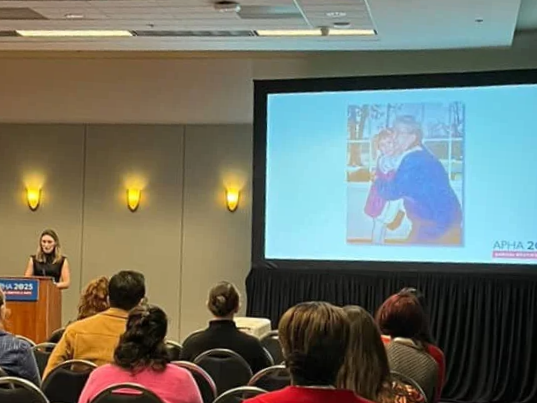
Zoe presenting at the 2025 APHA Annual Meeting in Washington, DC.
“Who Gets to Age Well?”
Explores the intersection of bioethics, geroscience, and health justice to critique how longevity and healthspan advancements are distributed. The paper highlights the structural inequities that determine who reaches older age with dignity versus who faces premature decline, arguing for normative frameworks that prioritize equity in aging research. By reframing healthy aging as a public health imperative rather than a privilege, this work establishes actionable principles for policy, intergenerational justice, and community-based support.
“Who Gets to Age Well? “ is currently Under Journal Review.
2024-2025 Byron Hanke Fellowship
Abstract:
The global aging population, with one in six people projected to be over 60 by 2030, presents urgent challenges, notably heightened risks of loneliness and social isolation among older adults that severely impact health and well-being. This study investigates the critical role of community associations (CAs) in addressing these issues by improving infrastructure and fostering intergenerational connections. Employing a mixed-methods approach, the research surveyed residents to gauge their intentions to age in place, willingness for social engagement, and caregiving needs, while interviewing CA management to understand operational realities, barriers, and opportunities. Quantitative results from resident surveys reveal a strong desire to age in place (64%) and belief in neighborly interactions (86%), coupled with an unmet desire for more community engagement (80%). Crucially, over 90% of communities currently lack formal caregiving resources. Qualitative findings from management highlight significant challenges, including financial limitations, liability concerns, and technological resistance among older residents, but also underscore the vital role of security and the potential for CAs to foster highly active, socially connected environments. These findings demonstrate a critical service gap within CAs and identify key barriers to evolving into supportive multigenerational living environments. The study offers recommendations for CAs, policymakers, and researchers to enhance infrastructure, facilitate informal and formal support, and promote intergenerational integration, ultimately contributing to improved health outcomes and a higher quality of life for aging residents.